

CRO Services
Purpose of CRO (Clinical Research Organization) Services
Medical device CRO services aim to efficiently lead and successfully complete clinical trials and medical device development processes on behalf of manufacturers.
Through activities such as clinical trial design, planning, monitoring, support for MFDS and IRB approval, and preparation of result reports, CRO services target regulatory compliance, quality assurance, and savings in time and cost—enabling manufacturers to develop and market safe, effective medical devices.
CRO Services Overview
KGS KOREA serves as a reliable partner across every stage of medical device clinical trials—design, planning, execution, monitoring, and reporting.
Clinical Trial Design
Based on extensive experience with diverse medical devices, we provide systematic, efficient clinical trial design. We develop optimal protocols aligned with the sponsor's objectives and requirements and establish thorough plans for trial success.
Clinical Investigation Plan (CIP) Preparation
The clinical investigation plan is a core document describing trial objectives, methodology, statistics, and organizational structure. We prepare it in the appropriate standard format for the device, reflecting product characteristics and regulatory requirements, together with supporting documentation for review and approval.
MFDS and IRB Approval
Medical device clinical trials require approval from the Ministry of Food and Drug Safety (MFDS) and the Institutional Review Board (IRB). We support timely approval through close coordination with MFDS and expert guidance on required documents and procedures.
Clinical Trial Monitoring
Our specialist monitoring team thoroughly oversees trial progress. On-site monitoring ensures data accuracy and consistency, effective quality management, and resolution of issues to help ensure successful trial conduct.
Result Report Preparation
Clinical trial result reports are critical evidence of sponsor success and product performance. KGS KOREA performs rigorous analysis and prepares clear, scientifically sound reports.
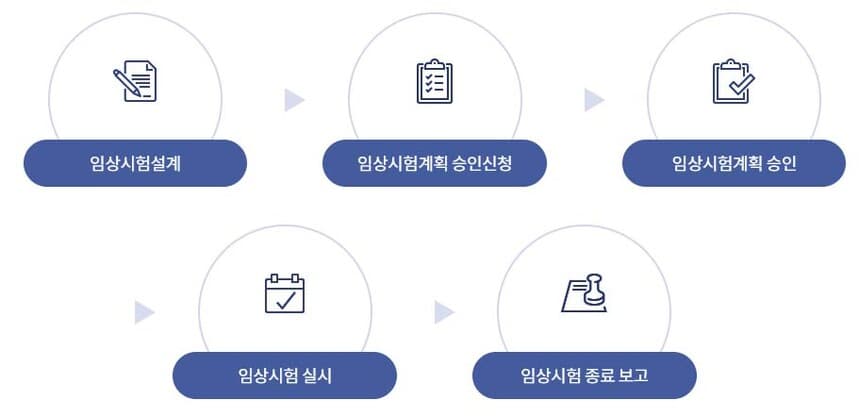
What is a medical device clinical investigation?
A medical device clinical investigation is a test or study in humans (and human data) to demonstrate the safety and effectiveness of the device used in the investigation.
Experimental studies in humans must address ethical considerations: avoid unnecessary harm to subjects, protect human dignity, respect patients as persons, and obtain informed consent after fully explaining the study's purpose, content, and potential benefits and risks.
What is a clinical investigation plan (CIP)?
A clinical investigation plan is a document describing the trial's objectives, research methodology, statistical considerations, and related organizations to provide background and rationale for the investigation.
It is not merely a record of research content but a manual covering the entire study from start to finish, developed through adequate review and discussion. Requirements vary by device purpose and use; the plan must be prepared in a format appropriate to the device.
Characteristics of medical device clinical trials
Unlike pharmaceutical trials, medical device trials typically involve procedures. Sponsors may find it difficult to demonstrate clinical effectiveness even after developing high-performance devices because, unlike drug trials that can use double blinding and placebos in large populations, device trials are heavily influenced by operator skill and procedural characteristics.
It is also difficult to apply devices to many subjects simultaneously, which constrains multi-center scientific and statistical proof of safety and effectiveness. Direct patient procedures make double blinding and sham-device comparative trials generally infeasible—key characteristics of device clinical investigations.
Required Contents of the Clinical Investigation Plan (Table of Contents)
1. Title of the clinical investigation
State the specific purpose of the investigation to demonstrate the safety and effectiveness of the investigational device.
2. Name and location of the investigating site
The site must be designated by the MFDS Commissioner as a medical device clinical investigation institution under the applicable MFDS notification.
3. Names and titles of the principal investigator, sub-investigators, and co-investigators
The principal investigator is responsible for conduct of the investigation at the site. Sub-investigators perform or decide investigation-related tasks under delegation and supervision. Co-investigators include medical/statistical and device specialists.
4. Name and title of the device administrator
Identify the clinician, biomedical engineer, nurse, or other person designated by the site director to store and manage the investigational device.
5. Name and address of the sponsor
Provide information on the person with responsibility for planning, management, and financing of the investigation—typically the manufacturer or importer of the device.
6. Objectives and background of the investigation
Objectives: specific description of safety and effectiveness evaluation. Background: rationale for the trial, general product information, development history, mechanism of action, design features, materials and composition, performance, novel manufacturing methods, and other relevant specifics.
7. Intended use of the investigational device
Describe the intended use and scope of use, including target disease or indication.
8. Inclusion criteria, exclusion criteria, number of subjects, and rationale
Subject numbers must be sufficient to meet trial objectives, justified by hypotheses, significance level, power, statistical methods, and expected effect sizes from prior studies or literature. Sample size must be statistically valid for the design, primary endpoint, and analysis plan. Apply recognized medical device clinical statistics guidance for calculation.
9. Duration of the investigation
Specify periods for recruitment, observation and conduct, statistical analysis, report preparation, and IRB review from MFDS plan approval, with supporting rationale.
10. Investigation methods
Detail device configuration and preparation, subject preparation, application site selection, step-by-step use procedures, observation periods, and concomitant therapies.
11. Observations, clinical tests, and assessment methods
Include subject identification codes, demographics and medical history, clinical assessments (primary/secondary effectiveness and safety), adverse event follow-up, and tools and timing for each observation.
12. Anticipated adverse effects and precautions for use
Describe potential adverse effects and precautions during the investigation.
13. Stopping and withdrawal criteria
Define stopping rules (serious adverse events, safety concerns, subject refusal, death or illness preventing continuation), handling of data at stop, and withdrawal criteria (e.g., concomitant surgery, drugs, or devices affecting results).
14. Effectiveness evaluation criteria, methods, and interpretation
Define primary endpoints (main measures to demonstrate objectives) and secondary endpoints (additional measures), with evaluation and interpretation methods.
15. Safety evaluation criteria, methods, and reporting (including adverse effects)
Cover complaint-based and examination-based criteria, severity and incidence analysis, classification of severity, all enrolled subjects as the evaluation population, and recording of symptoms and onset/resolution dates.
16. Informed consent form
Subjects must receive full information via the subject information sheet and voluntarily confirm participation by signature before enrollment; include the consent form template in the plan.
17. Other matters necessary to conduct the investigation
Include compensation rules for injury, case report forms (CRFs), contracts (finance, delegation, obligations), and supply, receipt, storage, use, return, and disposal of investigational devices with records. Requirements vary by device; use appropriate forms for the product concerned.
Objectives of Clinical Investigations
The objective is to verify, in humans through scientific and ethical methods, that a newly developed device is safe (without undue adverse events or side effects) and effective for its intended diagnostic or therapeutic use.